
Technical Guide · · 7 min read
Helical Screw Piles vs Concrete Foundations: A 2026 Comparison Guide
When does a helical screw pile beat a poured concrete pad — and when does concrete still win? A practical comparison from the CGS Construction team.
By CGS Construction
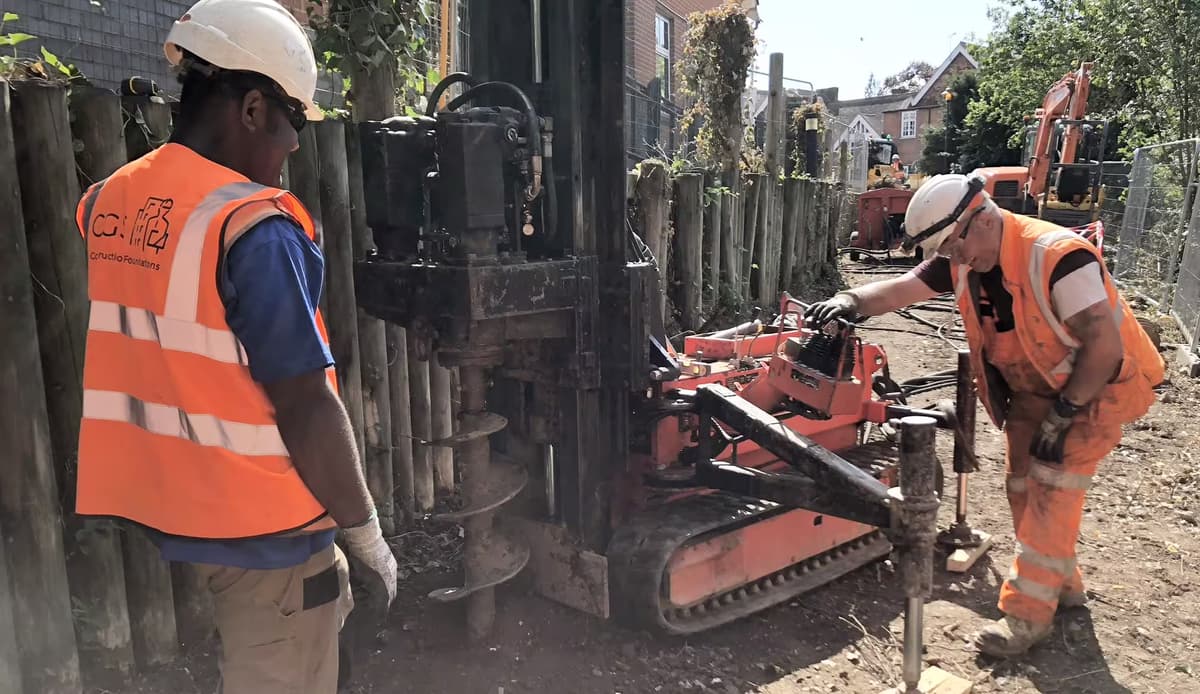
A helical screw pile is a steel shaft with one or more helical plates that is hydraulically rotated into the ground to form a load-bearing foundation. A concrete pad or strip footing is a poured-in-place foundation that transfers load through bearing on the soil beneath it. Both are valid choices on UK projects in 2026 — but they perform very differently on programme, carbon and access. This guide sets out where each option earns its place, based on what we see across live commercial, residential, telecoms and utilities work.
The practical difference in one paragraph
A helical pile reaches its design capacity within minutes of installation: torque measured during the screw-down correlates directly to load capacity, so the structural team gets immediate confirmation that the pile is good. A concrete foundation needs excavation, formwork, reinforcement, the pour itself, and a curing period of typically 7 days for partial loading and 28 days for full design strength. The “time to load” gap between the two is one of the single largest factors in choosing between them.
Programme and site impact
For a typical UK residential or light-commercial scheme, helical piling can complete a foundation package in days rather than weeks. There’s no concrete delivery to coordinate, no muckaway lorries shifting spoil, and no curing window holding up the trade following on. On a phased site, a screw-pile rig can move through plots without disturbing surrounding works.
Concrete remains the workhorse where the foundations also need to act as the ground-floor slab, retaining wall, or basement structure. In those cases the bulk and continuity of poured concrete is part of the design intent and the comparison doesn’t really apply.
Site impact is where the difference becomes visceral. A helical pile rig can be configured to under 1.8 m wide for tight residential sites, and the absence of spoil removal eliminates the heavy-vehicle movements that tend to draw planning conditions and complaints. On telecoms and utilities sites, where access roads are often unsealed and the equipment has to fit through gates designed for agricultural use, this matters.
Cost — when does each win?
Direct cost comparison is misleading without the surrounding works. On a like-for-like supply-and-install basis, helical piles are often more expensive per pile than equivalent concrete pads. The economics flip once you account for:
- Spoil disposal: a single concrete pad foundation can generate 2–4 m³ of spoil. At typical UK tip rates and haulage, this adds meaningfully to the bill.
- Programme acceleration: piles can be loaded the same day. On a project where the critical path runs through the foundation, this is a measurable saving in prelims and finance.
- Reinstatement: helical piles leave the surrounding ground undisturbed. Concrete excavation requires reinstatement that often eats into landscaping budgets.
- Plant standing time: concrete requires multiple plant disciplines (excavator, pump, vibrator) on site over multiple days. Helical piling typically uses one rig for one visit.
For projects with awkward access, environmental constraints, or short programmes, helical piles are often cheaper on full project cost even when their unit rate is higher.
Carbon and sustainability
Embodied carbon has moved from “nice to track” to “specifier requirement” on UK public-sector and ESG-led private work. Concrete is responsible for roughly 8% of global CO₂ emissions, and Portland cement specifically is the high-impact ingredient.
A helical screw pile is a galvanised steel shaft. Steel has its own carbon cost, but the mass of material per unit of load capacity is far smaller than the equivalent concrete pad — particularly for foundations that need to resist uplift or work in cohesive soils with low end-bearing capacity.
In practical terms, on the schemes we benchmark, replacing a concrete pad foundation package with helical piles typically reduces foundation embodied carbon by 50–80%, depending on ground conditions and the steel sourcing decision. Combine with low-carbon mortar bedding and recycled-content cladding and the savings compound.
When concrete still wins
We don’t recommend helical piles on every site. Concrete remains the right choice when:
- The foundation is also the floor: where a slab-on-grade or raft is the design, the comparison isn’t really between methods — concrete is doing two jobs.
- Lateral loads dominate: tall, slender structures with heavy wind loading sometimes need the rotational stiffness that a wide pad gives. A pile group can match this, but the pile count and design complexity can erase the cost advantage.
- Bedrock is shallow and fractured: helical piles need a coherent torque profile to confirm capacity. On heavily fractured rock, the torque trace can be misleading and a designed concrete plinth on competent rock is more reliable.
- Heritage or conservation reuse: where existing concrete foundations can be retained and over-built, the embodied carbon of the existing structure is already “spent” — reusing it almost always beats new piles.
Quick-reference comparison
| Factor | Helical screw piles | Concrete pad/strip |
|---|---|---|
| Time to full load | Same day | 7–28 days |
| Spoil generated | Minimal | Significant |
| Vibration | None | Moderate during excavation |
| Restricted-access suitability | Excellent | Variable |
| Embodied carbon per pile/pad | Lower (steel) | Higher (Portland cement) |
| Best for | Telecoms, utilities, residential, restricted access | Slabs, basements, large pads, fractured rock |
| Typical install crew | 2–3 people | 4–8 people across trades |
Frequently asked questions
Are helical screw piles permanent?
Yes. Galvanised helical piles installed in non-aggressive soils have an expected design life in line with the structure they support — typically 60+ years. For aggressive ground conditions (acidic, saline, high chloride), specifying epoxy-coated or stainless variants extends design life further.
Do helical piles need a concrete cap?
Most projects use a small reinforced-concrete pile cap or a steel bracket connection to transfer load from the structure to the pile. The volume of concrete is a fraction of an equivalent pad — typically 5–15% by volume — and is a significant carbon saving.
What ground conditions are unsuitable?
Helical piles struggle in very loose granular fills, voided or made ground without a reachable competent stratum, and heavily contaminated brownfield where penetration risks redistributing contamination. A site investigation will surface these — they’re the same conditions that complicate any foundation design.
How is load capacity verified?
By the torque-correlation method during installation: the rig records torque against depth, and capacity is calculated from a project-specific torque-to-capacity factor calibrated for the helix and shaft geometry. On larger or more critical schemes, a proof-load test on a sacrificial pile confirms the correlation.
If you’re scoping a project where foundations are on the critical path or carbon is a specifier requirement, get in touch — our team can run a feasibility comparison against your site investigation in days.