
Technical Guide · · 9 min read
Light Gauge Steel Framing (LGSF) Explained: A UK Developer's Guide for 2026
What LGSF actually is, where it earns its place over timber and traditional steel, and what UK developers should specify to get the best result.
By CGS Construction
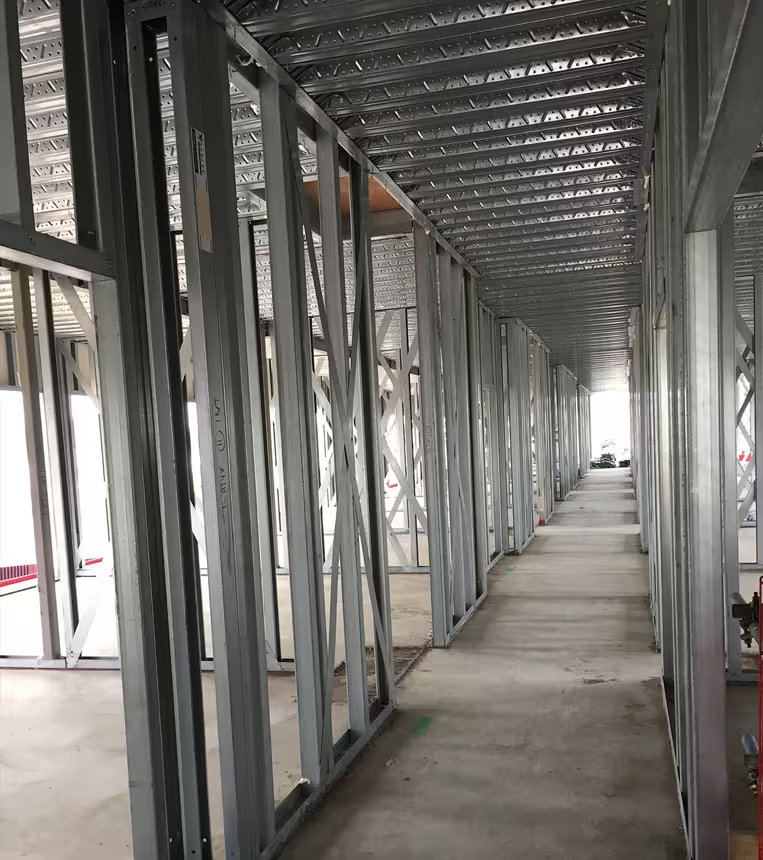
Light Gauge Steel Framing (LGSF) is a construction method that uses cold-rolled, galvanised steel sections — typically between 1 mm and 3 mm thick — to form load-bearing wall, floor and roof systems. Sections are manufactured off-site to digital cutting files and either delivered as flat-pack components for on-site assembly or as fully pre-panelised wall and floor cassettes that are erected on the foundation in days.
For UK developers in 2026, LGSF sits in the sweet spot between traditional masonry and full volumetric modular: it offers most of the programme, quality and carbon advantages of off-site manufacture without the logistical complexity of moving complete modules on the highway network.
The principle in one paragraph
A coil of galvanised structural steel goes into a roll-forming machine. CAD geometry from the structural model drives the cuts, holes and notches. The output is dimensionally precise C-sections, U-tracks, joists and rafters. Those components are assembled into walls, floors and roof panels in a controlled factory environment, transported to site flat or pre-panelised, and erected on a prepared foundation. The frame is dry, dimensionally true, and ready for the M&E and finishes to follow.
Why developers are switching to LGSF
The industry conversation has moved on from “is off-site cheaper than on-site?” — most schemes now find the answer is “it depends.” The clearer question is: “what does the project actually need, and which method gets us there?” LGSF wins on five things consistently:
1. Programme certainty. Factory output isn’t weather-dependent. A typical UK residential block can have its frame to weather-tight in weeks rather than months, and the certainty of the programme lets following trades plan with confidence.
2. Dimensional accuracy. Tolerances are typically ±2 mm at component level. Bricklayers and finishing trades arrive on site to a frame that’s straight, plumb and square — which protects margin in the trades that follow.
3. Embodied carbon. Steel has a known carbon profile that can be specified and reduced with recycled content and electric-arc-furnace sourcing. Compared with traditional cavity-wall masonry, LGSF typically reduces foundation loads (less mass overall) and can cut whole-frame embodied carbon by 20–40% with the right specification.
4. Acoustic and thermal performance. Modern LGSF systems easily meet Approved Document E acoustic separation and Approved Document L thermal requirements, often using less wall thickness than equivalent masonry — recovering net internal area on tight urban plots.
5. Health and safety. Off-site manufacture moves a substantial proportion of work hours from the construction site to a controlled factory environment. The CIRIA and HSE statistics on off-site versus on-site injury rates are well-documented and not flattering to traditional methods.
Where LGSF works best
Not every scheme is a good LGSF candidate. The method earns its place on:
- Mid-rise residential (typically 4–8 storeys, with hot-rolled steel taking over above)
- Social housing where programme certainty is contractually critical
- Care and student accommodation where repetitive room layouts amortise the design effort
- Hotel and hostel schemes where modular cellular units suit the system geometry
- School and education projects where holiday-bound construction windows reward speed
- Telecoms shelters and utility cabinets where the same precision matters at smaller scale
It works less well on highly bespoke architectural one-offs with non-repeating geometry, or on conversion projects where existing structure dominates the design.
The off-site / on-site continuum
LGSF spans a range of off-site intensity:
| Approach | Description | When to use |
|---|---|---|
| Stick build (kit of parts) | Sections cut to length, erected on-site | Bespoke geometry, restricted access |
| Pre-panelised open | Wall panels with insulation and sheathing, no services | Standard mid-rise — most common in UK |
| Pre-panelised closed | Walls with services, insulation, internal lining | Programme-critical schemes |
| Volumetric pods | Bathroom or kitchen modules within an LGSF frame | Hotels, student rooms |
Most UK developers using LGSF in 2026 specify pre-panelised open systems — the sweet spot of factory benefit and on-site adaptability.
Programme and cost benefits
Direct comparison with masonry is hard because LGSF moves cost from one bucket to another. What we see consistently:
- Foundation savings: lower self-weight typically allows 15–30% reduction in foundation volume.
- Cladding compatibility: LGSF accepts virtually any cladding system — brick slip, render, terracotta, ACM (with appropriate fire compliance), timber rainscreen.
- MMC benchmarks: schemes meeting “MMC Category 2” (pre-manufactured 2D primary structural systems) qualify for funding routes and planning incentives in some local authorities.
- Reduced rework: dimensional accuracy means the cumulative cost of “small adjustments” — packers, shims, re-cuts, finishes following waviness — drops sharply.
The headline cost per m² is usually within 5% of comparable masonry. The full-project cost is typically lower once programme, foundations, defects and sequencing are accounted for.
Common misconceptions
“Steel rusts.” Galvanised structural sections in a properly detailed warm-frame envelope have a design life that exceeds the building’s intended use. The galvanised coating is sacrificial and well-understood; specification just needs to match the environmental class.
“Steel is cold.” Thermal bridging through metal studs is the legitimate concern, but modern LGSF detailing uses thermal break strips, isolated cladding rails, and external insulation to comfortably meet U-value targets that masonry struggles with.
“Steel sounds hollow.” This is a 1990s-era memory of poor-quality drywall partitions, not modern LGSF construction. Properly specified LGSF wall buildups using two layers of acoustic plasterboard, mineral wool, and resilient bars meet or exceed Part E.
“Steel is too rigid for movement.” LGSF systems are designed with controlled deflection limits and use isolation joints exactly as masonry does. The dynamic behaviour of mid-rise LGSF buildings is well-documented in BSI and Eurocode-referenced guidance.
How LGSF integrates with other trades
The transition from frame to follow-on trades is where LGSF projects either run smoothly or run into trouble. Three principles consistently work:
-
Set the M&E coordination upstream. Pre-panelised systems have service penetrations, conduit routes and rail positions baked in at the factory. The drawings need to be M&E-coordinated before manufacture starts. This is a behaviour change for teams used to running services on a “build first, fit later” basis.
-
Specify the cladding interface explicitly. A brick slip on EML cladding behaves differently to a rainscreen on top-hat rails. The frame manufacturer needs to know which one to design for.
-
Treat foundations as a separate package. The foundation contractor doesn’t need to know it’s an LGSF building above — they need a precise setting-out, a level pad, and the bolt-down details. Helical screw piles work particularly well here because they can be installed before the frame is finalised.
Frequently asked questions
Is LGSF accepted by UK building control?
Yes, comprehensively. LGSF systems are designed to BS EN 1993-1-3 (Eurocode 3 Part 1-3) with verified system-supplier guidance. UK Approved Documents A, B, E, K and L are all routinely satisfied. Most LGSF systems also carry BBA or LABC certification.
What about fire?
LGSF wall buildups achieve up to 120 minutes of fire resistance with standard plasterboard linings. The structural steel itself loses strength in fire — exactly as hot-rolled steel does — and the gypsum lining is the protection. The detailing rules are mature and well-tested.
How does it compare to timber framing?
LGSF and timber frame compete in the same mid-rise market. Steel wins on programme certainty (no moisture cycle waiting), dimensional accuracy, and post-Grenfell scrutiny on combustibility. Timber wins on biogenic carbon credit and tooling familiarity. The decision is usually project-specific.
Can LGSF buildings be extended later?
Yes, more easily than masonry in many cases. The steel frame is engineered, drawn and traceable — extensions can be designed against the original analysis, and the steel-to-steel connection details are well-established. Adding a storey to a designed LGSF building is a recognised approach when initial design accounts for it.
Specifying LGSF on an upcoming scheme? Talk to our team — we work with developers from RIBA Stage 2 onward and can run a method comparison alongside your structural engineer.