
Sustainability · · 8 min read
Reducing Embodied Carbon in Foundations: Five Practical Strategies
Foundations can account for up to 20% of a building's embodied carbon. Here are five practical strategies to bring that figure down on real UK projects.
By CGS Construction
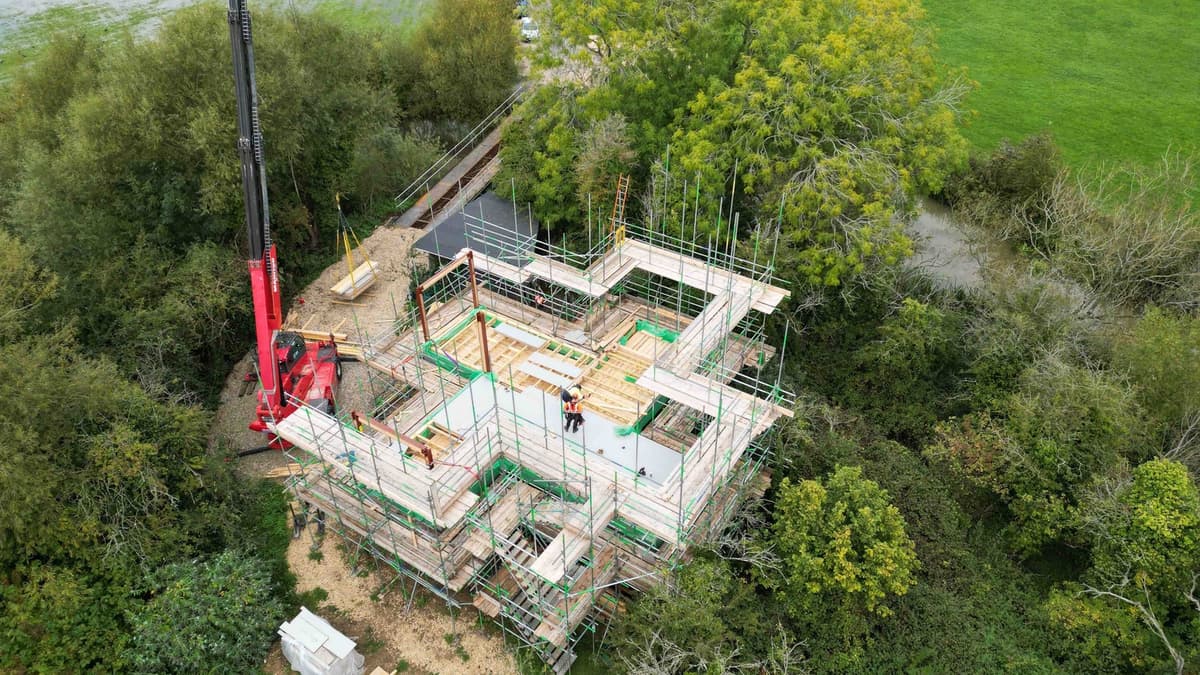
Embodied carbon is the greenhouse-gas emissions associated with the materials and construction processes of a building, before it’s occupied. For most UK developments, foundations account for 10–20% of whole-life embodied carbon — disproportionately high relative to their share of cost or visible structure. With the RIBA 2030 Climate Challenge targets tightening and the Greater London Authority’s Whole Life Carbon Assessment now mandatory for major schemes, foundations have become a measurable, reportable line item.
This article sets out five strategies that we apply on real projects to bring foundation embodied carbon down. None of them require novel technology. All of them are commercially available in 2026.
Why foundations matter for carbon
Foundation packages are typically dominated by Portland cement-based concrete, and Portland cement is responsible for around 7–8% of global CO₂ emissions. The chemistry is hard to escape: producing one tonne of cement releases roughly 0.6 tonnes of CO₂ from the calcination reaction itself, before any kiln fuel is burned. Reinforcement steel adds further carbon, although recycled-content rebar from electric-arc furnaces has a much lower profile than primary steel.
The good news: foundation design has more degrees of freedom than people assume. The embodied carbon of a foundation package can typically be cut by 40–70% without losing any structural margin — using methods that are already proven and procurable.
Strategy 1: Choose helical screw piles where ground allows
A galvanised steel helical pile uses far less material per unit of load capacity than an equivalent concrete pad foundation. Even accounting for the carbon cost of steel production, the total embodied carbon per pile is typically 50–80% lower than a concrete pad designed to the same load.
The constraint is ground conditions. Helical piles need a coherent torque profile during installation to verify capacity, which means they suit cohesive soils, granular soils with reasonable density, and competent (non-fractured) rock. They struggle in very loose fills, peat, and heavily voided made ground.
Practically, this means helical piles are a strong choice for:
- Residential schemes with reasonable ground conditions
- Telecoms shelters and utility cabinets
- Solar farms (where pile count is high and savings compound)
- Restricted-access urban infill where excavation is awkward anyway
Site investigation tells you whether the option is open. When it is, the carbon delta is significant.
Strategy 2: Optimise the concrete mix
Where concrete is the right method, the largest carbon lever is the mix design itself. Modern UK ready-mix suppliers offer:
- GGBS (ground granulated blast-furnace slag) replacement — substituting 50–70% of Portland cement with GGBS, a steel-industry by-product. This typically cuts mix carbon by 35–50% with no loss of strength, although early-age strength gain is slower (a programme implication).
- PFA (pulverised fuel ash) — a coal-power-station by-product, replacing 25–35% of cement. Now constrained by reduced coal generation, but available.
- Limestone-calcined-clay cement (LC3) — emerging blend with very low clinker content, available in some UK markets and growing.
- Recycled aggregate — replacing primary aggregate with crushed concrete from demolition, with up to 20% replacement now standard in CEM I/II concrete without strength penalty.
The specifier’s leverage here is permission. Many engineers default to CEM I (pure Portland) concrete for foundation pours because that’s what their reference details assume. Specifying that all foundation concrete shall use CEM III (≥36% GGBS) or equivalent removes the default-Portland reflex and lets the supplier propose the lowest-carbon mix that meets the structural requirement.
Strategy 3: Right-size the foundation depth and width
This is the unsexy strategy that gets the largest gains on average projects. Foundation design is conservative by nature — engineers add safety margin on top of code-required margin, especially when site investigation data is sparse.
Three steps cut this in practice:
- Invest in a thorough site investigation. A £5,000 ground investigation that reduces foundation depth by 200 mm across a scheme can save tens of thousands in concrete and tens of tonnes of CO₂.
- Use observed-performance methods. Eurocode 7 explicitly allows design via observation of nearby similar foundations. On infill plots in established urban areas, the data exists.
- Right-size by calculation, not by precedent. Pad foundations on commercial schemes are routinely oversized “because the engineer designed the same thing on the last job.” Reviewing each foundation against actual loads, soil parameters and partial factors typically shaves 10–20%.
Right-sizing has zero capital cost. It’s the highest-return carbon reduction available on most projects.
Strategy 4: Reuse existing foundations where possible
The lowest-carbon foundation is one that already exists. On urban infill, brownfield, and heritage-adjacent schemes, the existing foundations from the previous structure are often serviceable for a new building of similar or lighter form.
Reuse strategies range from:
- Direct reuse — building on top of existing foundations after structural assessment
- Augmentation — extending or strengthening existing foundations to match new loads
- Stitching — connecting new isolated pads to the existing grid via beams
The structural assessment is the gating step. CIRIA C667 and the Institution of Structural Engineers’ guidance on existing foundation reuse are the relevant references. Where reuse is viable, it eliminates the entire foundation embodied carbon — by definition, the lowest-carbon option.
Strategy 5: Specify low-carbon reinforcement
Reinforcement steel is the second-largest carbon contributor in a foundation package. The lever here is procurement specification:
- EAF (electric-arc-furnace) recycled-content rebar — typically 95%+ recycled content from UK and European mills (Celsa Steel UK is the dominant domestic supplier). Carbon profile is 30–50% lower than primary steel.
- Avoid stainless except where genuinely required. Stainless rebar has a carbon profile around 4× that of standard rebar. It’s the right choice for marine and aggressive-chloride exposure — and the wrong choice when galvanised would have done the job.
- Specify minimum recycled content in the tender documents. Without an explicit requirement, the supplier picks whatever’s cheapest on the day.
The combination of EAF rebar and a CEM III concrete mix routinely halves the embodied carbon of a typical UK pad foundation, with no design change above ground.
Putting it together
These strategies stack rather than compete. A typical UK commercial foundation package combining:
- Helical piles where ground allows (or right-sized concrete where not)
- CEM III concrete mix with 50% GGBS
- EAF recycled-content rebar
- Site-investigation-led right-sizing
- Existing foundation reuse where the site allows
…will reach 50–70% embodied carbon reduction against the same package designed five years ago, with no programme penalty and often lower capital cost.
The barrier is rarely cost or technology. It’s specification. Foundation engineers, ready-mix suppliers and pile contractors can all deliver these reductions — but only if the design intent and the procurement documents tell them to.
Frequently asked questions
How is embodied carbon measured?
Through a Life Cycle Assessment (LCA) following PAS 2080, EN 15978 and the RICS Whole Life Carbon Assessment standard. The unit is kgCO₂e per m² (per kg, per pile, etc.). Most UK structural engineers now produce embodied carbon estimates as standard at RIBA Stage 4.
Are GGBS and PFA going to remain available?
GGBS supply is tied to UK steel production and is generally healthy. PFA is constrained by the wind-down of coal-fired power generation and is becoming scarcer. LC3 and other emerging cements are filling the gap.
Does low-carbon concrete cost more?
Marginally. Typical premium for CEM III over CEM I is 0–5% per m³. On a foundation package representing 5–10% of total project cost, the impact on the headline number is negligible. Procurement scale (project framework, multi-project agreements) often eliminates the premium entirely.
What’s a realistic carbon target for a UK foundation package in 2026?
For a mid-rise residential scheme, around 100–180 kgCO₂e/m² of GIA is achievable for the foundation package using the strategies above, against a 2020 baseline of 250–400 kgCO₂e/m². The RIBA 2030 target trajectory is the moving benchmark.
If your project has a Whole Life Carbon Assessment commitment or is targeting BREEAM Outstanding, we can help — we run carbon comparisons against site-specific ground conditions and structural loads at any stage from feasibility onward.